




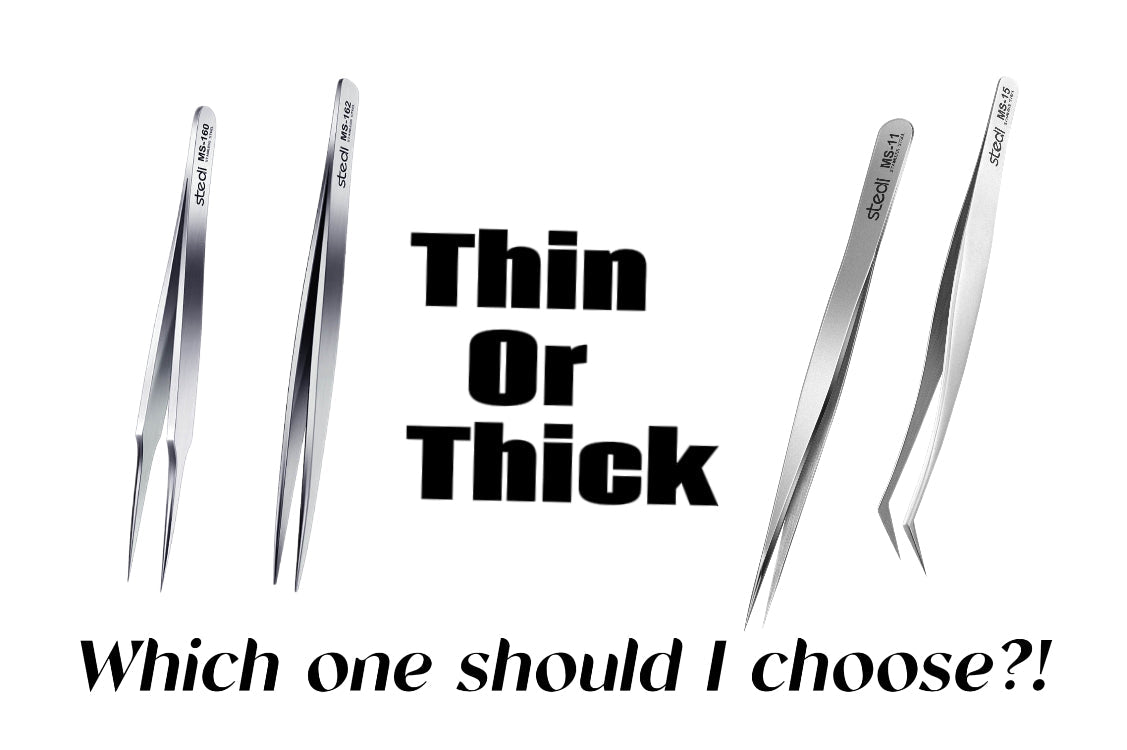
When working on a model, miniature, or other detailed project, the right pair of tweezers can make small tasks easier and more precise.
For model makers, the thickness and edge design of the tweezers can affect grip, control, durability, and handling comfort.
stedi offers different tweezers designs for different working preferences. Two options are the MS-11–15 thin-edge tweezers and the MS-160–162 thick-wall tweezers.
So, which type should you choose?
What Is the Difference Between Thin-Edge and Thick-Wall Tweezers?
The main difference is the construction of the tweezers body and edge.
Thin-edge tweezers have a slimmer edge profile, making them suitable for detailed work where precise access and control are important.
Thick-wall tweezers use a more substantial body design, providing a firmer feel and greater structural stability when gripping objects.

In simple terms:
Thin-edge tweezers prioritize fine access and precision, while thick-wall tweezers prioritize stability, strength, and durability.
STEDI MS-11–15: Thin-Edge Tweezers for Fine Detail Work
The STEDI MS-11–15 series features a thin-edge design for precision model-making tasks.
The fine edge allows you to work with small components while maintaining good control. The tweezers are also designed with a high-precision joint for stable gripping.
According to the product design, useful applications include:
- Handling small model parts
- Positioning decals and water-slide decals
- Precision assembly
- Miniature detailing
- Other small-object handling tasks
The surface uses a matte finish that helps reduce visible fingerprint marks, while the rounded chamfered edges provide a more comfortable grip during use.

Best for: model makers who prioritize a slim edge and precise handling.
STEDI MS-160–162: Thick-Wall Tweezers for Stable Grip
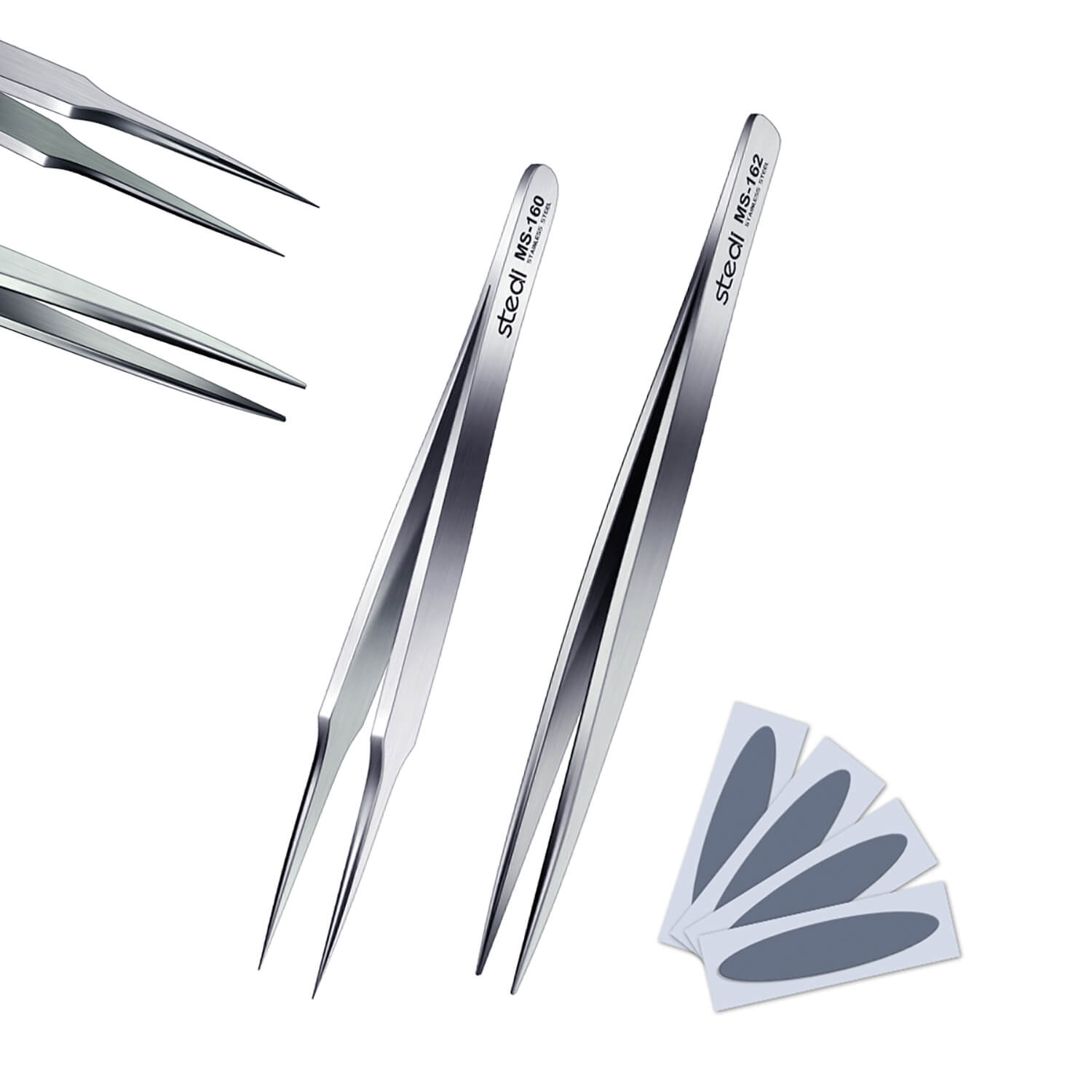
The STEDI MS-160–162 series uses a thicker tweezers wall for a more substantial and stable feel.
The reinforced construction helps the tweezers maintain their shape when gripping harder objects. They can also handle very fine objects, such as individual hairs, with precision.
Key features include:
- Thick-wall construction
- High-quality stainless steel
- Stable gripping
- Improved durability
- Comfortable grip with included grip pads

Best for: model makers who want a stronger, more durable tweezer with a solid grip.
Thin-Edge or Thick-Wall Tweezers: Which Should You Choose?
| Feature | MS-11–15 | MS-160–162 |
|---|---|---|
| Design | Thin-edge | Thick-wall |
| Main advantage | Fine access & precision | Stability & durability |
| Grip feel | Light and precise | Solid and substantial |
| Suitable for | Decals, small parts, detailing | Firm gripping and precision handling |
| Material | Stainless steel | Stainless steel |
| Best for | Fine detail work | Stable, durable handling |
If you mainly work with decals, small model components, and fine detailing, the thin-edge design of MS-11–15 is a practical choice.
If you prefer a more substantial, durable tweezers with a stable grip, MS-160–162 is a better option.
For model makers who work on different types of projects, having both designs in your toolbox gives you more flexibility.
Which Tweezers Are Best for Model Making?
There is no single best tweezers for every model-making task.
Thin-edge tweezers are better suited to fine, detailed handling, while thick-wall tweezers provide a stronger and more stable grip.
For Gunpla, scale models, miniatures, BJD projects, and other detailed hobbies, choosing the tweezers design based on the task can improve both control and efficiency.

STEDI MS-11–15 and MS-160–162 offer two different approaches to precision handling, allowing model makers to choose the grip and edge design that best matches their workflow.


Leave a comment
This site is protected by hCaptcha and the hCaptcha Privacy Policy and Terms of Service apply.